
Nursing Peer Feedback Examples: Turning General Comments Into Meaningful Observations
Nov. 5, 2026

“Great teammate.” “Strong communicator.” “Needs to take more initiative.” These comments may express an opinion, but they leave important questions unanswered. What did the nurse actually do? In what situation? What should the recipient continue or approach differently?
Useful nursing peer feedback examples describe a specific situation, an observable behavior, and its effect on the work or people involved. Constructive feedback also identifies an opportunity for reflection or a practical next step. The examples below show how to turn general comments into meaningful observations that recognize contributions and support professional growth.
Nursing Peer Feedback Examples at a Glance
Nursing peer feedback does not need to be lengthy to be useful. It needs enough detail to help a colleague understand the observation.
| Area of Practice | General Comment | Observation-Based Feedback |
| Teamwork | “You are a great teammate.” | “During our last shared shift, you offered to help with an admission when my assignment changed and confirmed which tasks still needed coverage.” |
| Communication | “You communicate well.” | “During handoff, you clearly identified pending tasks and gave me an opportunity to ask questions before we finished.” |
| Patient Education | “You are good with patients.” | “During discharge teaching, you invited the patient to explain the instructions in their own words and clarified the point they were unsure about.” |
| Accountability | “You are dependable.” | “When you agreed to follow up on a question from rounds, you returned with an update and clarified the next step with the team.” |
| Professional Growth | “You are eager to learn.” | “After asking for feedback about your presentation, you revised the material and explained how you incorporated your colleagues’ suggestions.” |
| Constructive Feedback | “You need to communicate better.” | “During yesterday’s handoff, I needed clarification about the pending follow-up tasks. Including those tasks and who will complete them would help me understand the next steps.” |
These are fictional examples for learning purposes. Adapt the structure to your organization’s expectations and describe only situations you actually observed. Keep patient-identifying information out of examples and use approved channels for feedback.
What Makes Nursing Peer Feedback Meaningful?
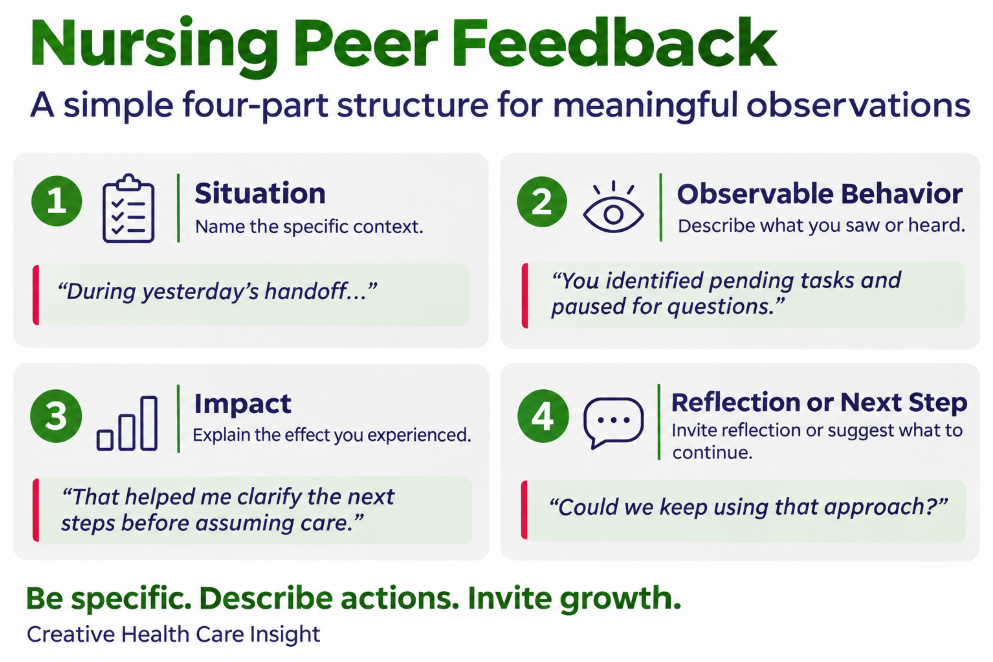
Meaningful peer feedback helps a colleague recognize a contribution or understand a development opportunity. It focuses on actions that can be described, discussed, and reflected upon. A useful structure is:
Situation → Observable behavior → Impact → Reflection or next step, when appropriate
For example: “During our team huddle, you asked colleagues to identify concerns before we finalized assignments. That gave me an opportunity to raise a workload issue while we could still discuss coverage.”
The comment identifies the context, describes the behavior, and explains its effect. The recipient can understand what was helpful and consider repeating it. When the impact is uncertain, describe your experience or ask a question. Avoid assuming that one observation proves a broader pattern or caused a particular patient outcome.
Positive Nursing Peer Feedback Examples
Positive feedback becomes more useful when it explains what a colleague should continue doing. These examples recognize contributions across several areas of nursing practice.
1. Teamwork and Collaboration
General comment: “You are always helpful.”
More meaningful feedback: “During our last shared shift, you checked in when my assignment changed and offered to help with an admission. We clarified responsibilities together, which helped me organize the remaining work.”
Why it works: The feedback identifies a specific contribution and explains how it supported a colleague.
2. Handoff Communication
General comment: “You give a good report.”
More meaningful feedback: “During yesterday’s handoff, you organized the report around current concerns, pending tasks, and follow-up needs. You also paused for questions, which helped me clarify the plan before assuming care.”
Why it works: It describes the communication behaviors the recipient can repeat.
3. Patient and Family Education
General comment: “You explain things well.”
More meaningful feedback: “During discharge teaching, you asked the patient to explain the instructions in their own words. When they were unsure about one point, you explained it another way and checked their understanding again.”
Why it works: It recognizes an observed teaching approach without assuming long-term understanding or outcomes.
4. Speaking Up and Advocacy
General comment: “You are a strong patient advocate.”
More meaningful feedback: “During rounds, you brought forward a concern the patient had shared and asked the team to address it before moving on. That gave the patient’s question a place in the discussion.”
Why it works: It connects advocacy with a specific action.
5. Supporting a Colleague’s Learning
General comment: “You are a great teacher.”
More meaningful feedback: “When I asked about a process I had not used before, you explained your reasoning, showed me where to find the approved resource, and invited questions. That helped me understand both the process and where to look for guidance.”
Why it works: It identifies how the colleague supported learning and access to reliable resources.
6. Accountability and Follow-Through
General comment: “You are reliable.”
More meaningful feedback: “After agreeing to follow up on a question from our meeting, you returned with an update by the time we had discussed. When one item was still unresolved, you explained what remained and who would follow up.”
Why it works: It makes dependability visible through communication and follow-through.
Constructive Nursing Peer Feedback Examples
Constructive feedback should make a development opportunity understandable. Describe the observation respectfully, explain its relevance, and invite discussion about what could help.
1. Making Handoffs More Complete
General comment: “You need to give a better report.”
More meaningful feedback: “During yesterday’s handoff, I needed to ask which follow-up tasks were still pending and who would complete them. Including that information in the initial report would help me understand the next steps. Could we use the unit’s handoff structure to make those items easier to identify?”
Why it works: It describes what was missing and suggests an existing structure that could support improvement.
2. Communicating Changes in Availability
General comment: “You need to be more considerate.”
More meaningful feedback: “When your availability changed during our shared assignment, I did not realize we needed to revisit coverage until I came looking for help. Letting me know when the plan changes would give us an opportunity to clarify responsibilities together.”
Why it works: It addresses communication without making a judgment about the colleague’s intentions.
3. Creating Space for Others to Contribute
General comment: “You dominate meetings.”
More meaningful feedback: “During our last council meeting, you responded before two colleagues finished sharing their ideas. I found it difficult to hear their full suggestions. Pausing before responding could give everyone more space to contribute.”
Why it works: It identifies an observable behavior and a practical adjustment.
4. Asking for Support Earlier
General comment: “You need better time management.”
More meaningful feedback: “During our shared shift, I learned you needed support with several remaining tasks near handoff. An earlier check-in would have given us more time to discuss available help. What would make it easier to raise those needs sooner?”
Why it works: It opens a conversation about support and workflow rather than assuming the cause of the difficulty.
5. Clarifying Shared Responsibilities
General comment: “You need to take more initiative.”
More meaningful feedback: “During our project meeting, we left without confirming who would complete two follow-up items. I was unsure whether you planned to take either one. At our next meeting, could we confirm an owner and timeline for each task before we finish?”
Why it works: It replaces an ambiguous expectation with a specific request.
6. Making Feedback More Actionable
General comment: “You are too negative.”
More meaningful feedback: “When we discussed the proposed workflow, you identified several concerns, but I was unsure which changes you recommended. Pairing each concern with a question or possible adjustment would help me understand your suggestions.”
Why it works: It addresses how concerns are communicated while leaving room for the concerns themselves to be heard.
How to Write Nursing Peer Feedback in Your Own Words
Examples can help you get started, but the final comment should reflect your own observation.
Start With a Situation You Remember
Choose a shared shift, meeting, handoff, teaching interaction, or project. A specific context is more useful than a broad statement about someone’s performance. If you have not observed the behavior being assessed, follow your organization’s process for indicating that you cannot provide an informed assessment.
Describe Actions Instead of Personality
Replace labels such as “difficult,” “lazy,” or “naturally talented” with a description of what the colleague did or said. For example, “You invited questions before closing the discussion” gives the recipient more useful information than “You are approachable.”
Explain the Effect You Observed
Describe how the behavior affected your understanding, the team’s work, or the interaction. Use language such as:
- “That helped me understand…”
- “That gave the team an opportunity to…”
- “I was unsure about…”
- “I needed clarification on…”
These phrases keep the comment grounded in an experience you can explain.
Add a Next Step When It Helps
Recognition may simply identify a behavior worth continuing. Constructive feedback can include a question, a specific request, or an invitation to discuss an adjustment. A reusable starting point is: “During [situation], I observed [behavior]. This [effect or experience]. [Question or next step, if appropriate].”
Review for Accuracy and Respect
Before submitting feedback, ask yourself:
- Did I directly observe what I described?
- Have I separated the behavior from my interpretation?
- Does the comment give enough context to be understood?
- Am I making an unsupported claim about someone’s intentions or outcomes?
- Does the wording follow our organization’s expectations?
Peer feedback should also follow the appropriate process. Concerns requiring immediate attention should be raised through the organization’s established channels rather than saved for a routine feedback cycle.
Use Examples to Support Your Organization’s Professional Practice Expectations
The most relevant feedback reflects what an organization expects professional practice to look like. If a feedback question addresses collaboration, describe an observed collaborative behavior. If it addresses accountability, describe follow-through, communication, or another action relevant to that expectation. This helps keep comments connected to the question being asked. It also gives recipients a clearer connection between everyday practice and their professional development.
When the challenge extends beyond wording – for example, inconsistent participation or uncertainty about how feedback will be used – explore why peer feedback programs fail and how healthcare organizations can strengthen them.
Connect Meaningful Feedback With Professional Growth
Specific observations give nurses something useful to recognize, reflect on, and discuss. A consistent process helps organizations collect those observations and connect them with professional development.
Creative Health Care Insight’s Professional Portfolio Suite includes a Peer Feedback Component that supports customizable questions, alignment with a professional practice model or organizational framework, and summary and detailed reporting. Organizations can use CHCI’s professional practice model foundation or bring their own preferred framework, connecting feedback with the expectations that matter to their teams.
CHCI is more than a platform. We work alongside healthcare organizations to strengthen the processes behind professional growth and configure technology to support them. Explore our Professional Portfolio Suite and connect with CHCI to discuss a peer feedback approach that reflects your organization’s goals.
Frequently Asked Questions About Nursing Peer Feedback Examples
A specific example is: “During handoff, you clearly identified pending tasks and paused for questions. That helped me clarify the next steps before assuming care.” The comment describes the situation, the observed behavior, and why it was helpful.
Describe a situation you directly observed, explain the behavior without judging the person, and identify its effect. Then offer a practical request or invite reflection. For example: “During our meeting, I was unsure who would complete the follow-up tasks. Could we confirm responsibilities before the next meeting ends?”
Avoid personality labels, assumptions about motivation, secondhand claims presented as observations, and generalizations such as “always” or “never.” Follow organizational privacy requirements and do not include patient-identifying information in illustrative examples.
Use examples as a guide to structure and specificity. Your final feedback should describe what you actually observed and answer your organization’s feedback question. Do not copy a comment that implies an interaction or behavior you did not witness.
Provide enough context for the colleague to understand what happened and what was helpful or could improve. A few clear sentences may be sufficient. Include relevant detail while following organizational expectations for privacy and documentation.