
How to Choose Annual Nursing Competencies for Your Unit
Nov. 25, 2026

Last year’s competency list can tell you what your unit assessed. This year’s priorities come from what nurses are being asked to do now. A revised handoff process, a shift in patient population, or a recurring concern raised by staff may all change what deserves attention.
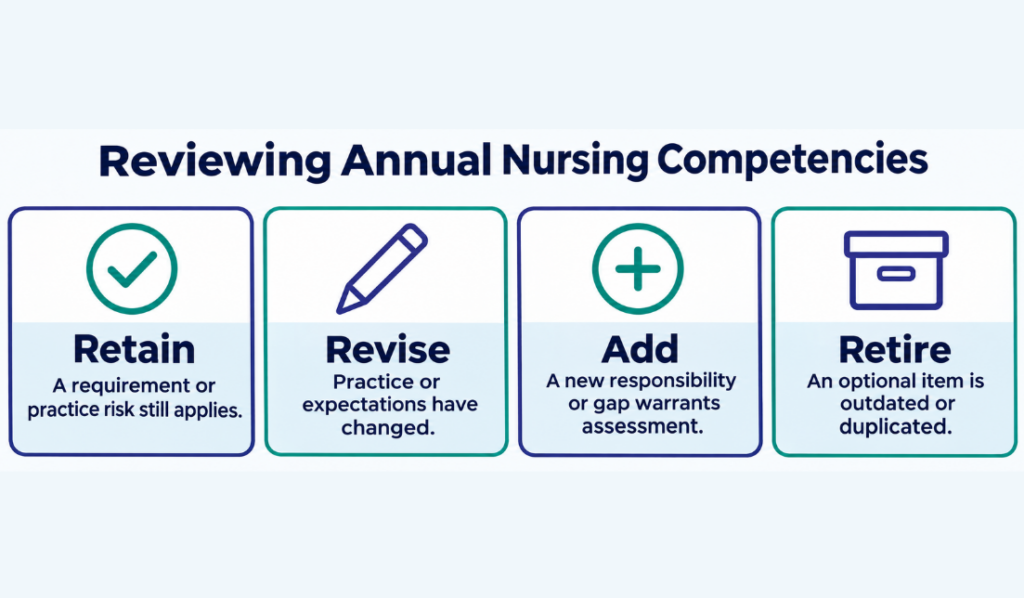
To choose annual nursing competencies, start with applicable requirements. Then ask direct-care nurses, unit leaders, and educators to review what has changed, where performance varies, and which gaps carry the greatest consequences. Use that discussion to decide what to retain, revise, add, or retire from the unit’s assessment plan.
Start With Requirements, Then Look at Unit Practice
Confirm which competencies apply to the role and what your organization requires for each. Separate those requirements from the topics your unit can select based on its own needs.
Bring direct-care nurses into the discussion early. Ask what has changed on their shifts, which situations are difficult to manage consistently, and which expectations have become harder to meet. Compare their observations with quality trends, audit findings, and changes in equipment, policies, or patient populations. Include high-risk situations that nurses encounter infrequently when they are relevant to the role.
UC Davis Health’s approach to competency management offers one example of how unit leaders and direct-care staff can identify ongoing competency priorities together.
Find Out What Is Driving the Gap
Suppose an inpatient unit introduces a revised shift handoff process. Early audits show that nurses sometimes omit pending follow-up tasks, and nurses on two shifts describe different problems. Some have trouble finding the prompt in the handoff tool. Others can find it and are unsure how to communicate who owns the next step.
The educator and unit team can work with the team responsible for the tool to make the prompt easier to find. If nurses still have difficulty communicating ownership, the unit can prioritize a specific competency for the affected role.
Communicate pending follow-up tasks and confirm who will take responsibility for them during shift handoff. That gives the unit a reason to include the competency and a clear expectation to assess. It also gives leaders a separate action to address the workflow barrier.
Decide What to Retain, Revise, Add, or Retire
Review each proposed topic alongside last year’s list. Record the decision, which roles it applies to, and the evidence behind it so next year’s team can see why it was chosen.
| Decision | When to Use it |
| Retain | An applicable requirement or current practice risk still warrants assessment |
| Revise | The competency still matters and a change in practice, equipment, or expectations calls for an update |
| Add | A new responsibility, significant practice change, or identified performance gap warrants focused assessment |
| Retire | A discretionary item is no longer relevant to the role or duplicates another assessment that covers the same expectation |
Once priorities are set, use CHCI’s nursing competency checklist guide to connect those priorities to observable expectations and meaningful evidence.
Support Ongoing Competency With CHCI
Creative Health Care Insight brings healthcare expertise, education, and implementation support together with technology. The CHCI Competency Suite supports ongoing competency assessment using your organization’s methodology or the Donna Wright Competency Assessment Model™. CHCI platform clients using the model also have exclusive access to education and consulting with Donna Wright herself.
Schedule a personalized demo to see how CHCI can help you put your competency priorities into practice across units.
Frequently Asked Questions
Use shared competencies where roles have common responsibilities or applicable organization-wide requirements. Choose additional competencies based on the unit’s patient population, responsibilities, and practice risks.
Bring together direct-care nurses, the unit manager, and a nurse educator or nursing professional development specialist. Quality, safety, and other teams can contribute data or clarify requirements when their work relates to the decision.
Yes. The annual review provides a regular time to revisit priorities. Changes in practice, new equipment, or emerging concerns may call for an update during the year.