
Career Ladder Portfolio Examples: What Counts as Evidence in Nursing?
Nov. 23, 2026

A nurse may spend months precepting a new colleague, testing a change to shift handoff, or helping a unit practice council solve a problem. When it’s time to apply for career ladder advancement, that work can be hard to capture in a few lines. “I served on the council” tells a reviewer where the nurse showed up. What did the nurse contribute while they were there?
A strong nursing career ladder portfolio entry connects a program criterion to the nurse’s specific contribution and evidence a reviewer can verify. The examples below show how to make that connection.
What Counts as Evidence in a Nursing Career Ladder Portfolio?
Evidence can include a project summary, approved meeting minutes, teaching materials, preceptor verification, or proof of certification. Start with your organization’s current criteria for the level you’re applying for. A certificate may be all you need to verify a credential. A quality improvement criterion may call for a short narrative and a project summary that shows your role.
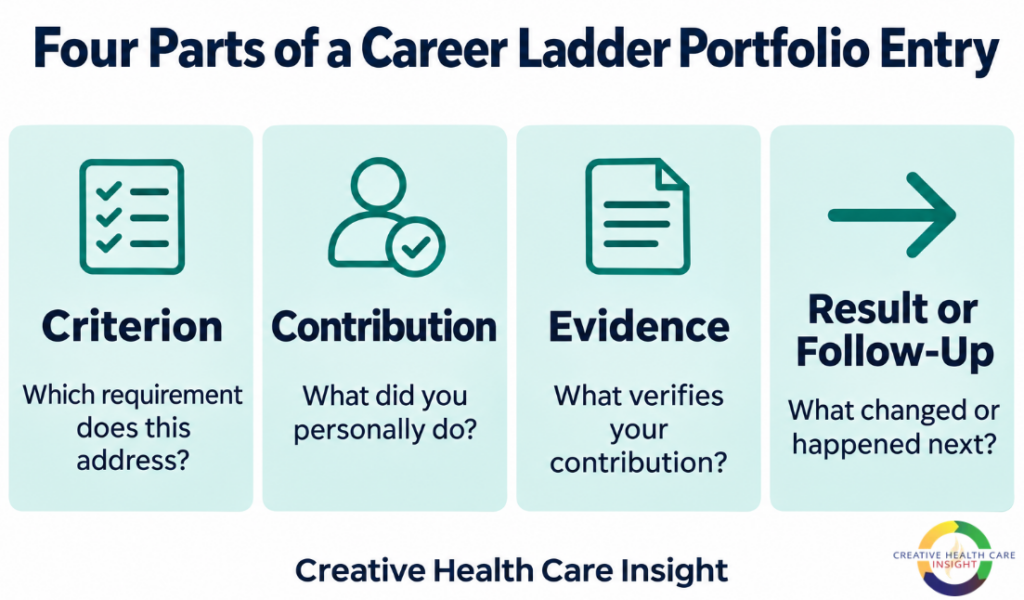
For contributions that need context, use four details:
- Criterion – Which advancement requirement does this address?
- Contribution – What did you personally do?
- Evidence – What document or verification supports your account?
- Result or follow-up – What changed, what did the team learn, or what happened next?
Four Nursing Career Ladder Portfolio Examples
These sample entries are illustrative. Use the evidence your organization accepts and follow its documentation and privacy policies.
1. Precepting a Newly Hired Nurse
During orientation, I noticed that a newly hired nurse could report assessment findings but needed practice identifying which changes to escalate. I used brief case discussions at the end of our shifts and gave feedback on how they explained their priorities. By our final check-in, the nurse could identify the priority concern and explain their next step in the cases we reviewed.
Possible evidence: Approved preceptor verification and a de-identified summary of the teaching approach and follow-up.
2. Contributing to a Quality Improvement Project
I helped our unit test a revised shift-handoff prompt. I collected feedback from night-shift nurses and brought it to the project team. Based on that feedback, the team moved the prompt to the point in handoff where nurses already discussed pending tasks. I helped summarize observations from the second test so the team could decide whether to continue using it.
Possible evidence: An approved project summary showing the nurse’s role, the revised prompt, and an aggregate summary of the test observations.
3. Participating in Professional Governance
As a unit practice council member, I gathered input from day- and night-shift nurses about which parts of our new staff resource guide were hardest to find. I grouped their feedback into three themes and presented them to the council. The council used those findings to revise the guide and asked me to collect feedback after the update.
Possible evidence: Approved council minutes documenting the recommendation, the revised guide, or council chair verification of the nurse’s role.
4. Developing Staff Education
I created a short teaching session after colleagues asked for help finding the current downtime documentation process. I built a practice scenario, led sessions during two shift huddles, and asked participants to walk through where they would find the form and how they would route it. Their questions helped me revise the reference sheet before it was shared with the unit.
Possible evidence: The teaching outline, an approved copy of the revised reference sheet, and educator or manager verification.
How Nurse Leaders Can Use These Examples
Give nurses and reviewers a sample entry tied to a criterion in your own program. For instance, if the criterion recognizes an active contribution to a practice council, explain what meeting minutes can verify. Minutes may record attendance, a recommendation the nurse presented, or an action they agreed to lead. Showing which detail matters gives applicants a clearer starting point and reviewers a shared reference. For teams setting those standards, see CHCI’s guide to building a nursing career ladder program.
Creative Health Care Insight helps healthcare organizations put career ladder standards into practice. With the CHCI Professional Portfolio Suite, nurses can document achievements and track their progress, while designated reviewers can verify submissions against the organization’s requirements. Through our recently announced partnership with Creative Health Care Management (CHCM), CHCI platform clients can also work with CHCM’s Cultures of Excellence consultants to clarify what counts as evidence, align advancement criteria with their professional practice model, and support implementation.
Schedule a personalized demo to see how CHCI’s platform and consulting support can help you put your career ladder program into practice.
Frequently Asked Questions
Include the documents required for the level you’re applying for. Depending on your program, these may include credential verification, project summaries, teaching materials, or a practice narrative. For each entry, make it easy to see which criterion the evidence supports.
If your program accepts team projects, describe your specific role and give the team credit for shared results. An approved project summary, meeting record, or project lead’s verification may help establish your contribution.
Check whether your program accepts work in progress. If it does, document what you’ve completed, what the team has learned so far, and what is scheduled next. Use verified results when available.