
Competency-Based Orientation in Healthcare: Moving Beyond Checklists to Competence
Jun. 22, 2026

For decades, healthcare orientation programs have relied heavily on checklists.
New employees complete required modules, attend classes, review policies, observe procedures, and check off required tasks. While these activities are important, they often create a critical challenge for healthcare leaders:
Completion does not necessarily equal competence.
A new employee may successfully complete every item on an orientation checklist and still lack the confidence, critical thinking, or clinical judgment needed to perform independently and safely.
As healthcare organizations face increasing workforce shortages, rising patient acuity, and growing demands for quality and safety, many leaders are rethinking how orientation is designed and measured. Rather than focusing solely on what employees have completed, organizations are increasingly adopting competency-based orientation models that prioritize what employees can actually do.
Competency-based orientation shifts the focus from task completion to demonstrated competence, helping organizations build stronger, more confident caregivers from the very beginning of their employment journey.
What Is Competency-Based Orientation?
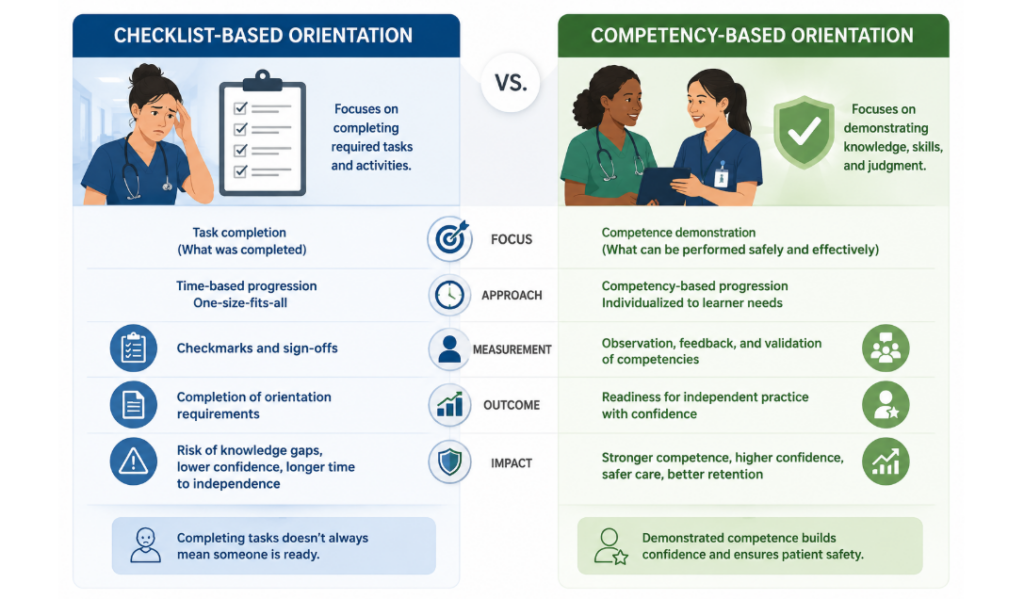
Competency-based orientation is an approach to onboarding that measures an employee’s ability to perform safely and effectively rather than simply tracking orientation activities.
Instead of asking: “Did the employee complete orientation requirements?”
Competency-based orientation asks: “Has the employee demonstrated the knowledge, skills, critical thinking, and judgment necessary to perform independently?”
This distinction is significant. Traditional orientation programs often emphasize time-based progression. Employees move through orientation according to predetermined timelines regardless of their individual experience, learning needs, or demonstrated competence.
Competency-based orientation recognizes that individuals develop at different rates and may require varying levels of support before achieving independent practice. The goal is not simply to finish orientation. The goal is to build competence.
The Problem with Checklist-Driven Orientation
Checklists serve an important purpose. They help ensure consistency, standardization, and regulatory compliance. However, problems emerge when checklists become the primary measure of orientation success. Many healthcare organizations unknowingly create situations where employees are evaluated based on activities completed rather than competencies demonstrated.
This can result in:
- Variable orientation experiences
- Inconsistent competency validation
- Knowledge gaps that remain undiscovered
- Reduced confidence among new employees
- Increased stress for preceptors and educators
- Longer time to independent practice
- Increased turnover during the first year of employment
Healthcare leaders frequently discover that employees who have successfully completed orientation still require significant support because competence was assumed rather than validated. The challenge is not the checklist itself. The challenge is relying on the checklist as proof of competence.

Why Competency-Based Orientation Matters More Than Ever
Today’s healthcare environment is significantly more complex than it was even a decade ago.
Organizations must prepare employees to navigate:
- Higher patient acuity
- Rapidly changing technology
- Interprofessional collaboration
- Evolving regulatory requirements
- Workforce shortages
- Increasing quality and safety expectations
New employees need more than information. They need confidence. They need critical thinking skills. They need opportunities to apply knowledge in real-world situations while receiving meaningful feedback and support.
Competency-based orientation creates a structured pathway that helps employees develop these capabilities while allowing leaders to better understand individual readiness for practice. As a result, organizations are better positioned to support patient safety, workforce retention, and long-term professional development.
The Role of TSAM® in Competency-Based Orientation
One of the most effective ways to operationalize competency-based orientation is through a structured framework such as the Tiered Skills Acquisition Model.
Developed specifically for healthcare, TSAM® helps organizations move beyond one-size-fits-all orientation programs by creating clear developmental pathways for competency progression. Rather than treating competence as a single event, TSAM® recognizes that competency develops over time.
The model provides a tiered competency framework for identifying:
- Foundational competencies
- Emerging competencies
- Advanced competencies
- Specialty-specific competencies
- Ongoing professional development opportunities
This tiered approach helps educators, leaders, and preceptors establish realistic expectations while providing employees with a clear understanding of their developmental journey. Most importantly, TSAM® helps organizations create consistency across departments while maintaining flexibility for individual learning needs.
Building a Competency-Based Orientation Program
Organizations seeking to strengthen orientation outcomes should focus on several foundational elements.
Define Required Competencies
Successful orientation programs begin with clearly defined competencies. These competencies should reflect the knowledge, skills, behaviors, and clinical judgment required for success in a specific role. Competencies should be practical, measurable, and aligned with organizational expectations.
Establish Clear Validation Methods
Competency validation should move beyond attendance tracking.
Organizations should incorporate methods such as:
- Direct observation
- Return demonstrations
- Simulation
- Case studies
- Peer feedback
- Competency conversations
- Scenario-based evaluations
Multiple validation methods provide a more complete picture of employee readiness.
Support Preceptors and Educators
Preceptors play a critical role in competency development. Providing clear expectations, training, and structured evaluation tools helps create more consistent orientation experiences while reducing preceptor burden.
Track Progress Over Time
Competency development should be visible. Organizations that leverage technology to track competency progression can more easily identify strengths, opportunities for support, and readiness for independent practice.

How Technology Supports Competency-Based Orientation
Managing competency-based orientation manually can be challenging, particularly in large healthcare organizations.
Technology can help streamline the process by providing:
- Centralized competency documentation
- Progress tracking
- Competency validation workflows
- Real-time reporting
- Automated reminders
- Skills gap identification
- Orientation milestone tracking
When competency management and onboarding processes work together, leaders gain greater visibility into employee development while reducing administrative burden. Technology also helps ensure consistency across departments, locations, and employee populations.

Competency-Based Orientation Improves More Than Orientation
One of the greatest advantages of competency-based orientation is that it creates a foundation for ongoing workforce development.
The competencies established during onboarding can continue to support:
- Annual competency assessment
- Career advancement pathways
- Succession planning
- Professional development
- Skills gap analysis
- Workforce readiness initiatives
Rather than treating orientation as a standalone event, organizations can use competency-based frameworks to support lifelong learning and continuous growth. This creates stronger alignment between onboarding, competency management, and long-term workforce development strategies.
Moving Beyond Completion Toward Confidence
Healthcare organizations invest tremendous resources in recruiting, onboarding, and developing employees. To maximize that investment, orientation programs must do more than document completed tasks. They must help individuals develop competence, confidence, and readiness for practice.
Competency-based orientation shifts the conversation from checking boxes to building capability. By focusing on demonstrated competence rather than simple completion, healthcare organizations can create more meaningful onboarding experiences, strengthen workforce readiness, and better support quality patient care.
Frameworks such as TSAM® provide a structured pathway for achieving these outcomes, helping organizations create consistent, scalable, and competency-driven orientation programs that prepare employees for success from day one.
Ready to Move Beyond Orientation Checklists?
Creative Health Care Insight’s Competency Management Suite helps healthcare organizations build competency-based orientation programs that support workforce readiness, competency validation, and ongoing professional development. Built for healthcare, by healthcare, our solutions, including TSAM® competencies and the exclusive rights to offering education and consulting services around its implementation, help organizations create structured pathways from onboarding to ongoing excellence.
Schedule a demo today to discover how CHCI can help your team build a stronger, more confident workforce.
Frequently Asked Questions
What is competency-based orientation in healthcare?
Competency-based orientation is an onboarding approach that focuses on validating an employee’s ability to perform safely and effectively rather than simply tracking completed orientation activities.
How is competency-based orientation different from traditional orientation?
Traditional orientation often focuses on completing required tasks and educational activities. Competency-based orientation focuses on demonstrating knowledge, skills, judgment, and readiness for independent practice.
Why are orientation checklists not enough?
Checklists help ensure consistency, but completing a checklist does not automatically prove competence. Employees must demonstrate their ability to apply knowledge and skills in real-world situations.
What is TSAM®?
The Tiered Skills Acquisition Model is a healthcare-specific framework that helps organizations structure competency development, orientation, and professional growth through clearly defined competency tiers.
How can technology support competency-based orientation?
Technology can help organizations track competency progression, manage documentation, automate workflows, identify skills gaps, and provide real-time visibility into employee readiness and development.
What are the benefits of competency-based orientation?
Benefits include improved workforce readiness, greater employee confidence, more consistent onboarding experiences, stronger competency validation, improved retention, and enhanced patient safety outcomes.