
LMS vs Competency Management System: What Healthcare Organizations Need From Each
Nov. 2, 2026

Your organization’s learning dashboard shows that required education is complete. Employees have reviewed the materials, finished their courses, and passed the knowledge assessments. What does that information tell you about their ability to apply what they learned?
For healthcare leaders, educators, and nursing professional development specialists, this question sits at the center of the LMS vs competency management system discussion. Education supports employee development, while competency assessment helps organizations evaluate how employees apply knowledge, skills, and judgment in practice. Understanding what each system contributes can help your organization identify gaps, evaluate technology, and build a more meaningful approach to workforce development.
LMS vs Competency Management System: What Is the Difference?
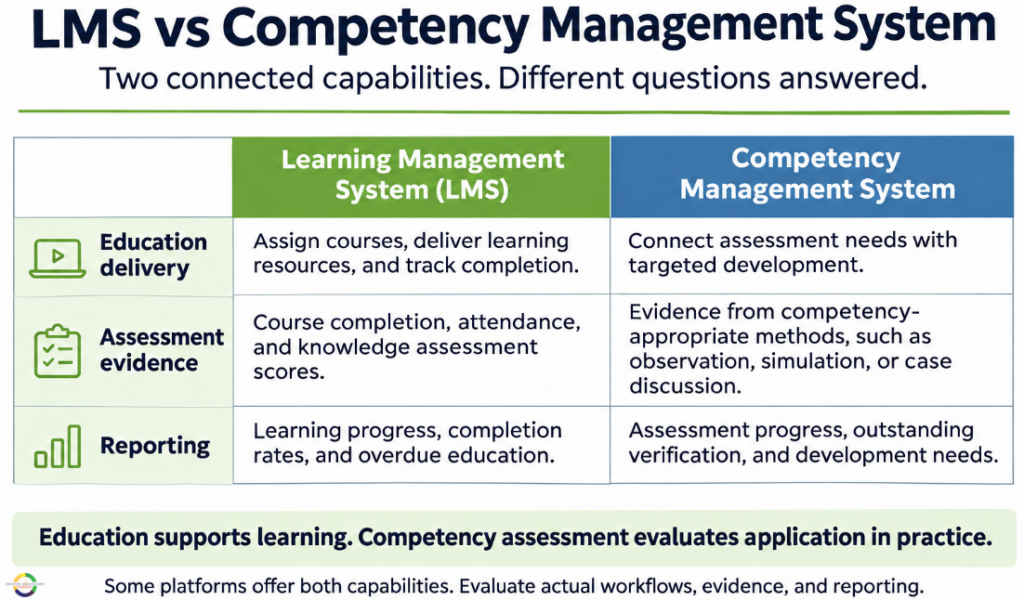
A learning management system (LMS) primarily supports the administration, delivery, and tracking of education. A competency management system supports the organization, assessment, documentation, and monitoring of role-relevant competencies.
Some platforms combine these capabilities. The important distinction is how effectively a system supports each process, including the evidence it captures and the workflows it enables.
| Area of Comparison | Learning Management Focus | Competency Management Focus |
| Primary purpose | Deliver and manage education | Support assessment of role-relevant performance |
| Common activities | Assign courses, distribute materials, administer quizzes | Define competencies, document verification, monitor assessment progress |
| Typical evidence | Course completion, attendance, assessment scores | Evidence from methods selected to evaluate the competency |
| Leader’s question | Has the employee completed the assigned learning? | What evidence supports the employee’s ability to meet the competency? |
| Development connection | Provide learning opportunities | Identify assessment needs and guide further development |
Actual capabilities vary by product. Healthcare organizations should evaluate the workflows available rather than relying on the software category alone.
What Healthcare Organizations Need From an LMS
An LMS provides structure for delivering education across departments, roles, and locations. It helps organizations make learning accessible and maintain records of participation and completion.
Depending on the platform, useful capabilities may include:
- Assigning education based on employee roles or responsibilities.
- Organizing courses and learning resources.
- Managing due dates and reminders.
- Delivering knowledge assessments.
- Tracking attendance and completion.
- Reporting on outstanding education requirements.
These functions help educators manage learning at scale. They also provide a record of the education employees have received. However, organizations still need to determine what conclusions they can draw from those records. A course completion report answers a different question from an assessment of performance in practice.
What Healthcare Organizations Need From a Competency Management System
A competency management system should support the assessment process your organization has intentionally designed. That starts with identifying meaningful competencies: the knowledge, skills, judgment, and behaviors employees need for their responsibilities. It continues with selecting appropriate verification methods, documenting evidence, and responding when further development is needed.
When evaluating competency management capabilities, consider whether the system can help your organization:
- Establish competencies relevant to different roles and practice settings.
- Support initial and ongoing competency processes.
- Use assessment methods appropriate to the competency.
- Clarify employee, preceptor, educator, and leader responsibilities.
- Document assessment evidence and progress.
- Identify where additional support or reassessment is needed.
- Review patterns that can inform education and development priorities.
The technology should support meaningful assessment, including the professional judgment required to interpret evidence and determine next steps.
Moving a paper form into a digital system can improve access and organization. Improving competency assessment also requires examining what is being assessed, why it matters, and how performance will be verified.
Why Training Completion and Demonstrated Competency Are Different
Consider an employee completing education about recognizing and responding to a change in a patient’s condition. The learning record may show that the employee reviewed the content and passed a knowledge assessment. That provides useful information about participation and understanding within that assessment.
The organization may also need evidence of how the employee recognizes relevant cues, communicates concerns, prioritizes actions, and follows appropriate escalation processes. Depending on the competency, suitable assessment methods might include observation, simulation, discussion, case-based assessment, or a combination of approaches.
Completing education can contribute to competency development. The evidence needed to assess competency depends on what the employee must demonstrate.
This distinction helps organizations avoid treating every completed learning activity as sufficient evidence of performance. It also helps educators choose development activities that address the employee’s actual needs.
When Healthcare Organizations Need Both Capabilities
Healthcare organizations often need to manage education and competency assessment together. During orientation, for example, a new employee may complete assigned learning while working with a preceptor to develop and demonstrate role-specific competencies. Leaders need visibility into both processes to understand progress and identify where support is needed.
For experienced employees, ongoing competency assessment may reveal a development need that leads to targeted education. Further assessment can then help determine whether that need has been addressed.
Whether these activities happen within one platform or across connected systems, organizations should clarify:
- Where learning records and competency evidence are maintained.
- How employees and assessors access their responsibilities.
- Whether information must be entered more than once.
- How leaders review progress across both processes.
- What integration or data exchange is actually available.
A combined platform may support these needs. Separate systems may also work well when responsibilities and information flows are clear. The right approach depends on the organization’s requirements and the capabilities of the specific products.
Questions to Ask When Comparing an LMS and a Competency Management System
A useful evaluation goes beyond asking whether a platform “has competency management.” Ask vendors to demonstrate how the system supports a real assessment process from your organization.
1. What does “complete” mean?
Does completion indicate that someone finished a course, submitted evidence, received verification, or met all assessment requirements? Leaders should be able to distinguish these statuses.
2. Which assessment methods can we use?
Can your organization select methods that fit the competency, or does the platform require the same process for every assessment?
3. How does the system support different roles?
Employees, preceptors, educators, and leaders may have different responsibilities. Ask how each person knows what to do and how progress is communicated.
4. What happens when someone needs additional development?
Explore how the platform documents learning needs, follow-up activities, feedback, and reassessment.
5. What can reports actually tell us?
A completion percentage can be useful, but leaders may also need to understand outstanding assessments, development needs, and patterns across teams.
6. What expertise supports implementation?
Technology decisions also affect assessment practices, communication, and program administration. Ask what education, implementation guidance, and ongoing support are available.
How CHCI Supports Meaningful Competency Management
Creative Health Care Insight combines healthcare-specific technology with education, consulting, implementation support, and ongoing guidance to help organizations strengthen workforce development.
CHCI’s Competency Suite supports both initial and ongoing competency management. Its Initial Competency Component accommodates either traditional orientation approaches or the Tiered Skills Acquisition Model, while its Ongoing Competency Component supports the Donna Wright Competency Assessment Model™ or an organization’s preferred assessment methodology. CHCI is the only legally authorized digital provider of the Donna Wright Competency Assessment Model™, offering organizations a platform designed to support this established approach.
For organizations evaluating an LMS vs competency management system, the starting point is understanding which learning and assessment processes need stronger support.
Explore CHCI’s Competency Suite to learn how technology and expert guidance can support your organization’s initial and ongoing competency processes.
Frequently Asked Questions
An LMS primarily manages education delivery and learning records. A competency management system supports competency assessment, including expectations, verification methods, evidence, and progress. Some platforms offer both capabilities.
Yes. Some learning management systems include competency management capabilities. Organizations should evaluate whether those functions support their assessment methods, evidence requirements, and workflows.
Course completion documents participation in a learning activity. It may contribute evidence toward a competency, but its sufficiency depends on the competency and the assessment requirements. Additional methods may be needed to evaluate application in practice.
Healthcare organizations generally need both learning management and competency assessment capabilities. Whether they need separate systems depends on their existing technology, program requirements, and the capabilities available within each platform.
It depends on the product. A competency management platform may not provide the course delivery and learning administration functions an organization needs. Evaluate both sets of requirements before deciding whether one platform can support them.